Story
ぐい呑み 「啓蔵虫喰い」が生まれるまで
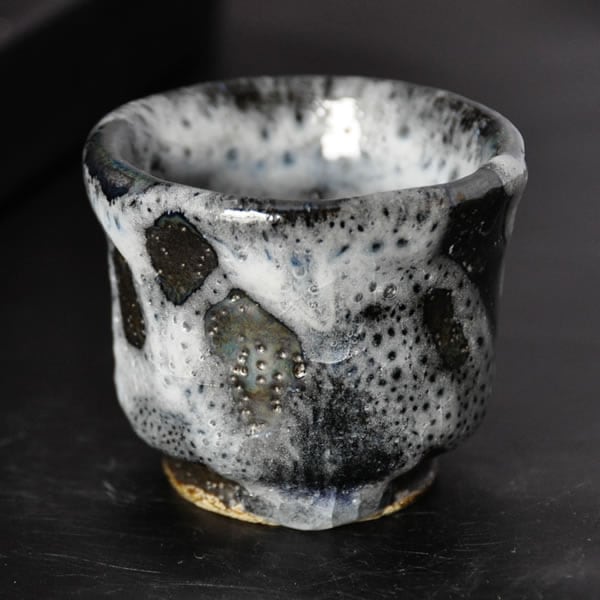
How the “Keizo Mushikui” Guinomi Came to Be
【050】「釉薬を重ねてかけるむずかしさ」
たっぷりと幾重にも釉薬をかけ、重なった色合いの発色が出た作品は、深みと変化を味わえると思います。
『啓蔵虫喰いぐい呑み 宇宙』(非売品)
は、特に、釉薬を重ねた中でも、技術的に難易度が高いものでしたが思いどおりに発色した作品です。(注1)
この「釉薬を重ねてかける」というのは、大変手間がかかります。
度目の釉薬をかけ、それを完璧に乾かしてから2度目に違う種類の釉薬をかけます。そして、それもまた完璧に乾かして、やっと3度目の釉薬となります。
なによりも「完璧に乾かした上で」次の釉薬をかけませんと、窯で焼成後取り出してみると、どろどろになって水ぶくれができたり、はがれたり(欠落したり)してしまうのです。
同時に、性質の違った釉薬をたっぷりと、しかも厚く重ねるというのは、大変むずかしい作業でもあります。
けれども、たっぷりと釉薬をかけるからこそ「虫喰い(注2)」ができ、複数の種類の釉薬を重ねてかけてあるからこそ「深い発色」が出るのです。
私自身、これまで何度も失敗を繰り返しながらも、「私なりの美」を求めて試行錯誤をしてきました。
それだけに納得のできる作品ができると、本当に達成感があります。
そして、実際に作品を手にとっての(お買い上げ頂いたお客様から)感想を読むと、作家として本当にうれしく、感謝の気持ちでいっぱいになります。
私のこの雑感をご覧になっているのは、(作品を)買って頂いた方だけではなく、陶芸に興味のある方、陶芸を勉強されている方も多いことでしょう。
もしも、そのような方々の参考になるのであれば、と思い、実際に失敗した作品(釉薬が欠落したものなど)をお分けします。
どんな感じになるのかなっているのかを実際に観察するだけでも、今後の陶芸や陶芸作品鑑賞に、なにかしらヒントになれば幸いです。
(注1)この作品は現在、販売終了。
(注2)ぼこっぼこっとあいた穴のこと
(2006.10.10 火曜日)
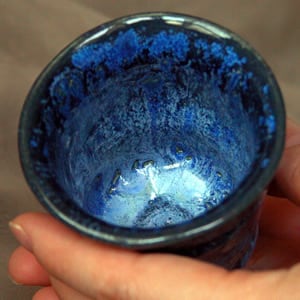
[050] The difficulty of layering glazes
When several glazes are applied generously in layers, the colors that emerge can hold a depth and quiet variation that a single glaze cannot produce.
One example is Keizo Mushikui Guinomi “Cosmos” (not for sale).
Among my works using layered glazes, this piece was particularly demanding from a technical point of view, yet it fired in a way that came close to what I had imagined.¹
Applying glazes in layers takes time.
First the initial glaze is applied. After it has dried completely, a different glaze is applied for the second layer.
Only after that has dried fully can the third glaze be added.
What matters most is allowing each layer to dry thoroughly before the next is applied.
If even a small amount of moisture remains, the piece may come out of the kiln with the glaze blistered, swollen, or partially peeled away.
Applying several glazes with different characteristics—thickly and generously—also requires care and patience.
Yet it is this generous application that allows the small pits known as mushikui² to appear.
And it is the layering of different glazes that brings out the depth of color.
Over the years I have repeated many failures while searching for a kind of beauty that feels right to me.
For that reason, when a piece finally emerges from the kiln in a satisfying way, the feeling is quietly rewarding.
And when I read the impressions of people who have held these pieces in their hands, I feel deeply grateful as a maker.
Many of the people who read these notes are not only those who have purchased my work, but also those interested in ceramics, or studying the craft themselves.
If it may be of some use, I sometimes offer pieces that did not succeed—such as those where the glaze has partially fallen away.
Simply observing how these pieces turned out may offer small hints for those making ceramics, or for those who enjoy looking closely at them.
If these notes can serve as a small reference in some way, I would be glad.
¹ This work is no longer available.
² Mushikui: small pits that appear in the glaze surface.
(October 10, 2006)
現在、新しいぐい呑みに取り組んでおります。
たっぷりもったりとした釉薬がかかったぐい呑みは温かい感じを受けますしそれが自分らしい作品だと思っています。
どこにもない、啓蔵らしい独創的な作品を作る、それが私の目標でもあります。
ですが、これまでにも何度か書いているように、長い経験をしても、なかなか思うような色が出ません。いや、うまくいくほうが少ないかもしれません。
今、新しいぐい呑みとして挑戦しているのは「碧がかかった黒色の地に、乳濁などの3種類の釉薬を重ねがけをする」作品です。
例えば三種類の釉薬を重ねがけをして発色を得るためには、単に三種類の釉薬を使うだけではうまくいきません。下地の釉薬に直接目的の釉薬をかけると、釉薬同士が混ざり合ってしまい、きれいな発色を得ることが出来なくなるからです。
ですので下地の釉薬と発色させる釉薬の間にそれぞれ別の釉薬をかけていきます。
しかしながら、それぞれ釉薬同士の相性がある上に、釉薬の中にはカイラギを消してしまうものもあるためになかなか簡単にはいきません。
それでも黒と白のはっきりとしたコントラストに加えて、微妙な色を表現してみたい、と思っています。
いつになるかわかりませんが、会心の作をお届けすることができたらと思います。
(2008.11.08 土曜日)
[053] A New Guinomi
At the moment I am working on a new guinomi.
The pieces I make often carry glazes that are applied thickly and generously.
They have a soft, warm feeling, and in many ways I feel this is closest to my own way of working.
My aim has always been to make something that feels truly my own—something you would not find anywhere else.
Yet, as I have written before, even after many years of experience the colors do not easily come out as I imagine.
In truth, success is the rarer outcome.
What I am now attempting is a new type of guinomi: a dark surface, slightly touched with blue-green, over which three different glazes—including a milky white—are layered.
To achieve the color I am looking for, it is not enough simply to apply three glazes one over another.
If the intended glaze is placed directly on the base glaze, the two tend to mix, and the clarity of the color is lost.
Because of this, additional glazes must be placed between them—each serving as a kind of bridge.
Even then, the process is not simple.
Each glaze has its own character, and some combinations do not work well together.
There are also glazes that erase the kairagi texture that I value, so careful balance is required.
Still, I would like to create a piece where the clear contrast of black and white is joined by more subtle colors.
I do not know when it will happen, but I hope that one day I will be able to present a piece that truly feels complete.
(November 8, 2008)
【啓蔵の近況】2014年2月 啓蔵お気に入りの作品 ぐい呑み「啓蔵虫喰い」
3月1日に、陶芸家 萩原啓蔵は87歳になりました。
少々耳が遠くなり、足が痛いことも多いようですが、作陶への意欲はまだまだ尽きないようです。
今回もお気に入りのぐい呑みについて語ってくれました。
『地の黒い釉薬にも、上からかかる乳濁の釉薬にも虫食いが出ているところが、なによりも違うと即答されました。
これがどんなにむずかしいことか、これが出たときどんなにうれしかったことか…
と語りながら、愛おしそうに、この作品をじっとみつめる啓蔵を見て、本当に思い通りの作品が出きたうれしさが伝わってきました。』
啓蔵は何度も、本当に何年も苦労を重ねてやっとできた作品、と言っていました。
一見シンプルにもみえる作品ですが、実は、何層にもかけた釉薬が融合して美しさを醸し出しています。
作品をみつめる陶芸家の眼差しは、作品への愛情が溢れているような気がしました。
(2014.03.08 土曜日)
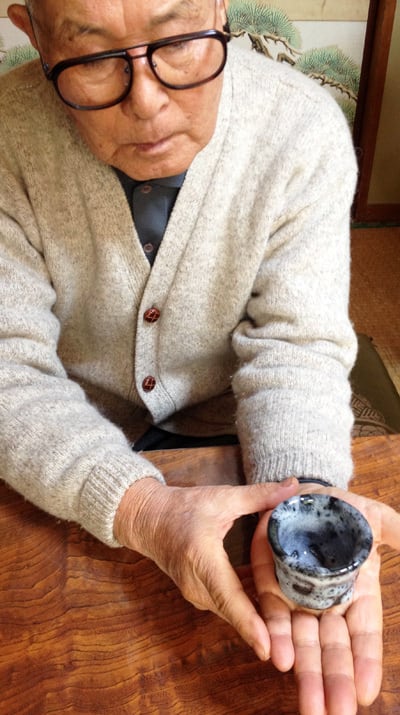
Keizo Notes
February 2014 — A Favorite Piece: Keizo Mushikui Guinomi
On March 1, ceramic artist Keizo Hagihara turned 87.
His hearing has grown a little weaker, and his legs often trouble him, but his desire to continue making pottery has not faded.
On this occasion, he spoke again about one of his favorite guinomi.
When asked what makes this piece different, he answered immediately:
“The mushikui appear not only in the black glaze of the base, but also in the milky glaze layered above it. That is what makes it special.”
He spoke about how difficult it was to achieve, and how happy he was when it finally appeared.
As he said this, Keizo looked at the piece quietly in his hands, almost as if he were looking at something dear to him.
Watching him, it was easy to feel how deeply satisfied he was to see the work turn out just as he had hoped.
He repeated several times that this was a piece that had taken many years of effort to achieve.
At first glance the work may appear simple, yet the beauty comes from several layers of glaze that have fused together in the firing.
As he looked at the piece, there was a sense that his gaze held a quiet affection for the work itself.
(March 8, 2014)